
Homemade Romanian sausages are made with a uniquely Romanian combination of seasonings that gives them their distinctive flavor. Garlic-forward, heat from ample black pepper, earthiness from summer savory and smokiness from smoked bacon. The meat is coarsely ground and stuffed into natural pork casings. Fried or grilled, they turn golden and crackly on the outside while staying moist and succulent on the inside.
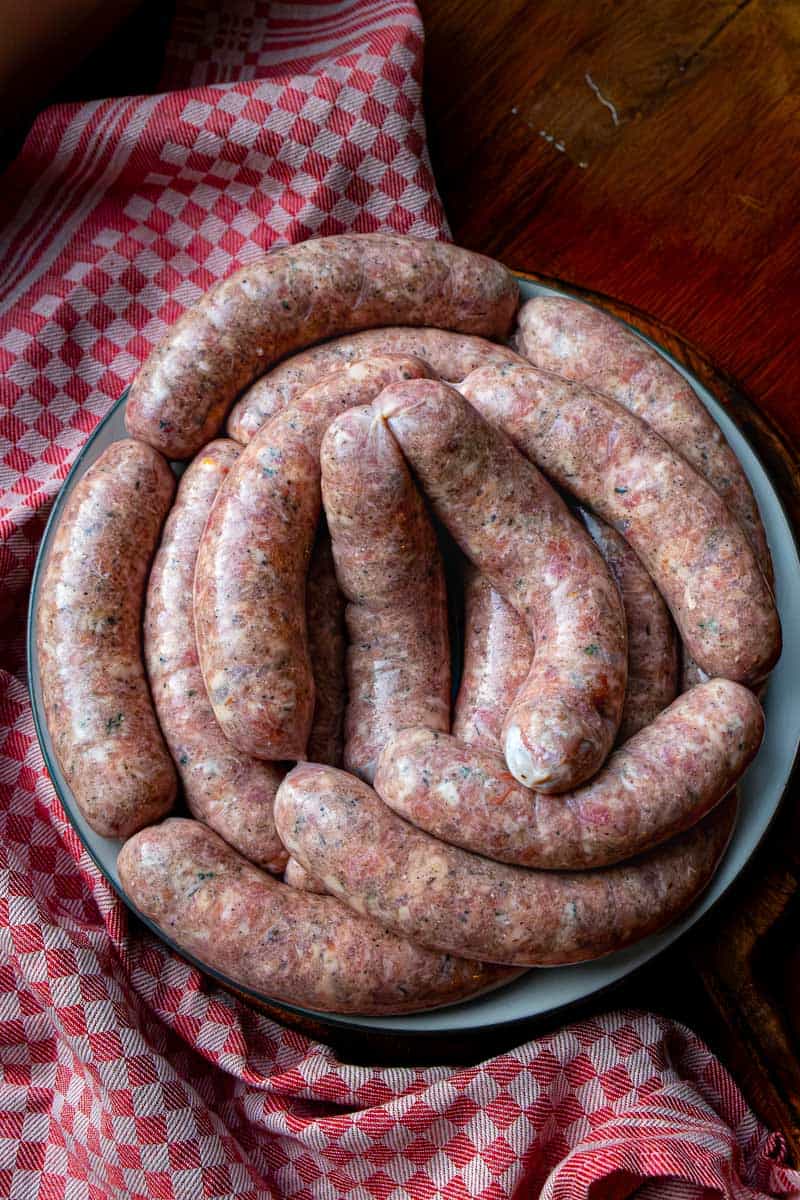
Romanian homemade sausages (cârnați de casă) are an important part of Romania's home butchering tradition and enjoyed throughout the country. This post gives you all the info you need to make your own Romanian sausages at home, and a bit of extra info on how this connects with Romania's cuisine.
If you've ever tasted them you know Romanian sausages have a unique and distinctive flavor and texture.
Coarsely ground pork belly, fat and smoked bacon are combined and seasoned well. They are garlic-forward with a strong undercurrent of heat from black pepper and earthiness from cimbru (summer savory).
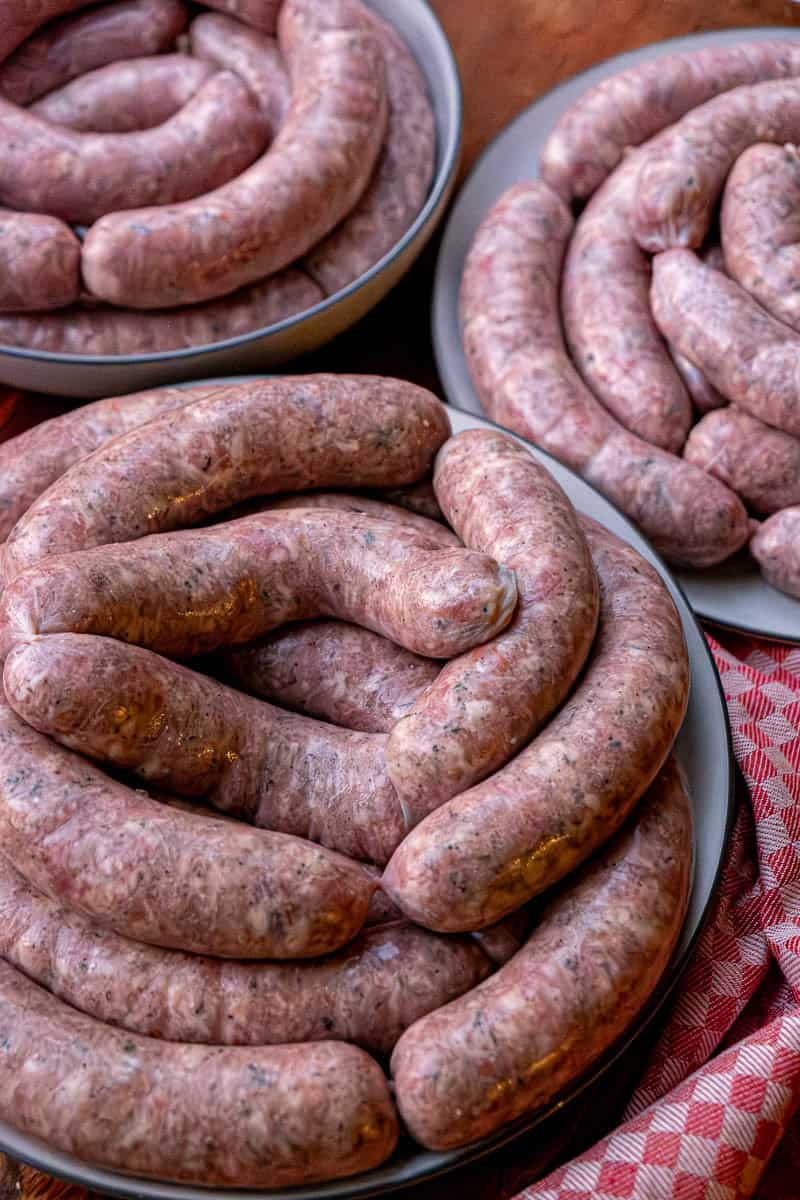
Enjoy them fried or grilled. The exterior gets a blistered golden brown texture while the interior stays juicy and soft, with clearly defined pieces of meat and fat. No emulsified meat paste in sight.
Table of contents
Homemade Sausages: Part of Romania's Home Butchering Tradition
In Romania many households spend the year growing a pig which is intended for slaughter just before the winter holidays. The pig slaughter is common throughout Romania and is in many ways synonymous with the holidays in Romania.
The core principle at the heart of the annual winter pig slaughter in Romania is that every part of the animal is used. This tradition has been around long before modern refrigeration, so many of the resulting preparations are intended to preserve meat for longer term use.
Some of the dishes commonly made:
- Meat: fried fresh for a dish called pomana porcului (a variant of tochitura that sometimes doesn't have sausages), ground for fresh sausages which can then be preserved by smoking.
- Head & ears: Head cheese (tobă) and meat aspic (răcituri / piftie);
- Blood: Blood sausages (sângerete);
- Offal (organ meats like heart, liver, lungs, kidneys etc.); sausages (caltaboș) sometimes also with rice, also head cheese (tobă) and meat aspic (răcituri / piftie);
- Fat: salt-cured or smoked fat (slănină) for eating or as addition in sausages or rendered into lard (untură); cracklings (jumări) after rendering fat.
The pig slaughter is not just a task to be completed: it's a much-loved tradition and a celebration where all members of the extended family come together, sometimes also with friends and neighbours, to work together towards a common goal and enjoy the fruits of their labor.
....the pig slaughtering tradition calls for țuica… It's served in shot glasses - but sipped, not shot… After the work is done, some families host what Romanians affectionately call pomana porcului, the pig's alms, a bounty of pork specialties to thank those who helped. Slaughtering the Christmas Pig in Romania by Andy Trincia
So loved is the tradition that it's even practiced in the diaspora: every winter my uncle in Toronto pools money together with a close group of friends to buy a pig (in this case, already slaughtered). Together they dispense with the preparations up at the cottage and each leave with a bounty to take home and enjoy through the holiday season.
These homemade sausages are one part of this broader tradition that you can prepare and enjoy at home.
Ingredients
This preparation was shared with me by my mother and my in laws.
As with most traditional recipes, Romanians tend to eyeball quantities and prepare based on instinct and experience. There's no set-in-stone recipe or ratio so I had to observe closely and measure regularly in order to pin down some basic quantities as shown in this recipe.
That being said, the recipe here (insofar as concrete quantities go) is meant as a starting point.
Add these quantities as a minimum and then fry up a small patty to taste and adjust the seasoning to your liking. This is the most important rule of sausage making.
The second most important rule is that there's a higher than average percentage of fat in Romanian sausages.
In fact, my mother in law shared with me that in the old days when meat was less abundant, it was common to stretch the meat with a lot more fat - even up to 50% meat and 50% fat. Nowadays 30%-50% fat is more common. The recipe shared here is about 40% fat to lean.
Percentages by component
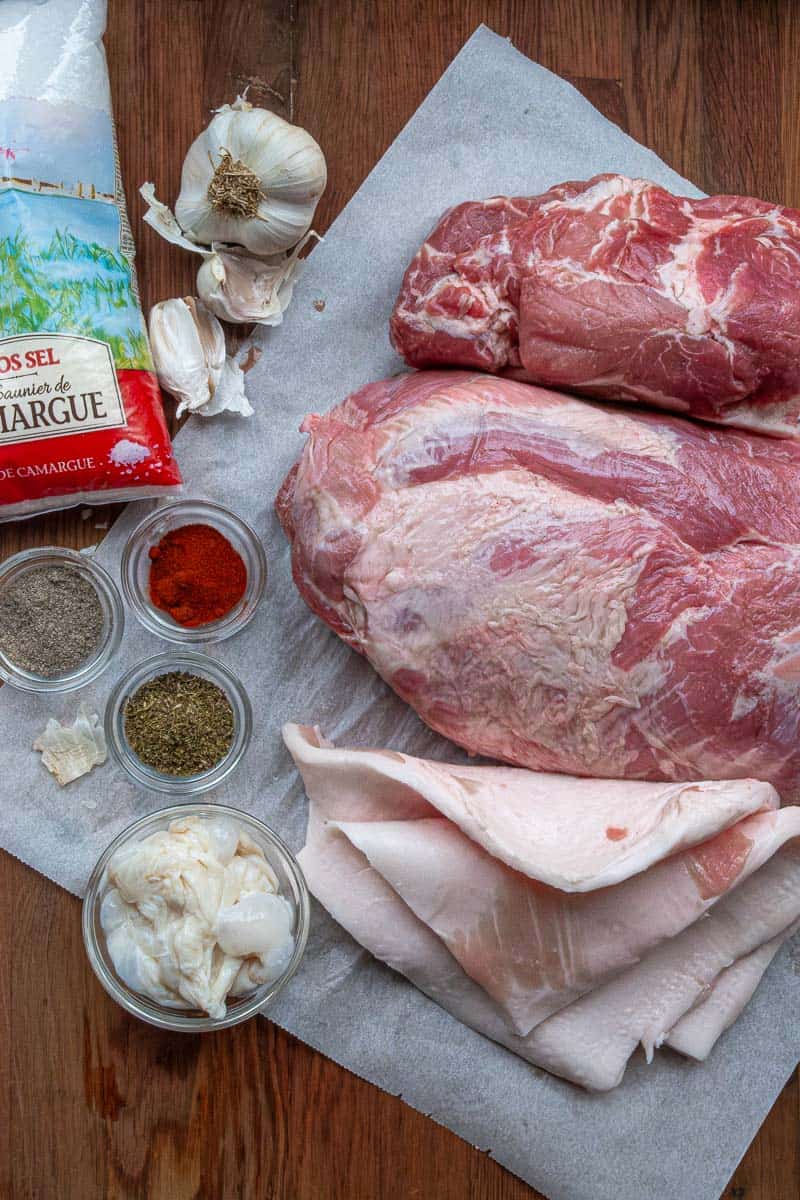
The ingredients are simple and as is usually the case with simple preparations, the characteristics and quality of the ingredients is of utmost importance.
3.7 kg (8.16 lb) pork neck (ceafă de porc): Choose well marbled meat with a good amount of fat. Pork shoulder can be substituted but neck is the gold standard. If in doubt ask your butcher for this specific cut.
700 grams (1.54 lb) pork belly fat: Literally pure fat. Firm and white fat like you'd use to make lard or cracklings.
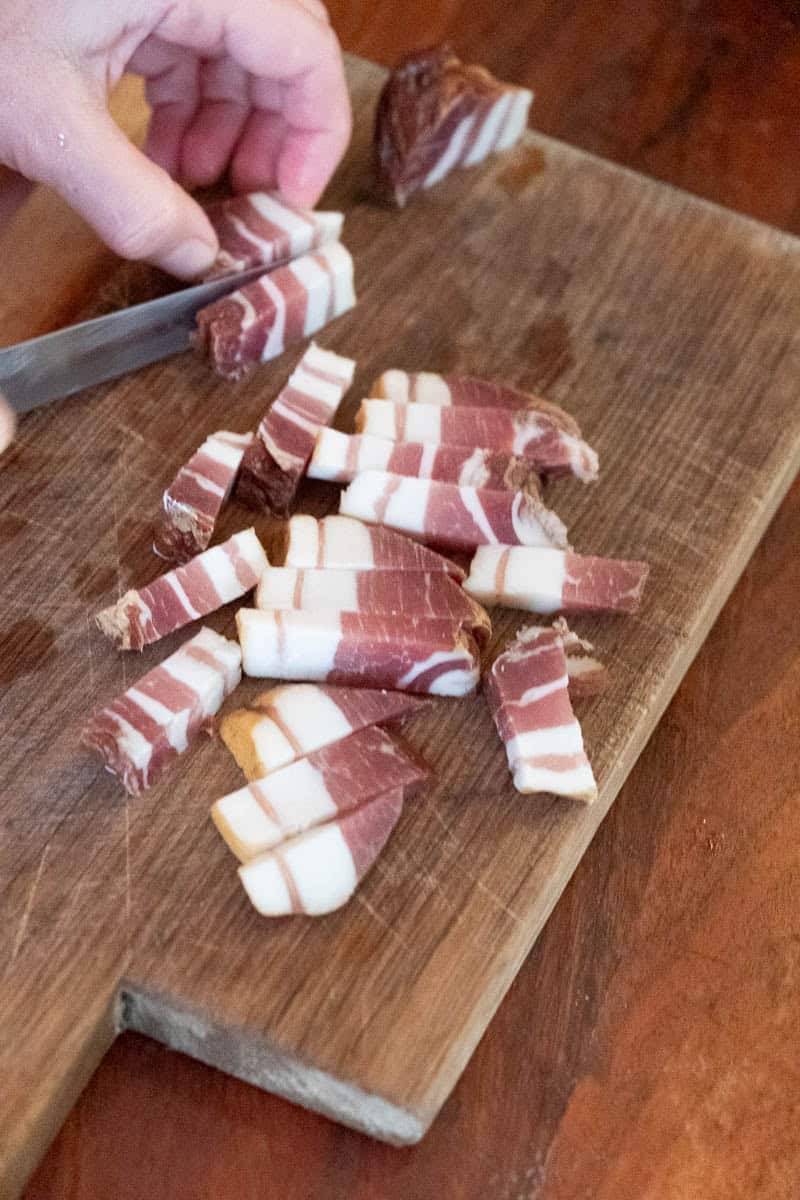
200 grams (0.44 lb) cold smoked bacon: Uncooked pork belly or slab bacon (in Romanian slanina afumată or șuncă afumată) with visible layers of fat and meat.
120 grams (0.26 lb) sausage casings from pork: Lamb casings can also be used but are a much lower gauge (narrower diameter), typically 1.5 to 2cm and will make a different shape sausage. They are also a bit more challenging to work with if it's your first time. Pork casings are higher gauge around 2-4cm, more typical for these types of winter sausages and easier to work with.
Seasoning:
- Salt: 80 grams (5 tablespoons). This is around 2% or 18-20 g (1 tablespoon plus 1 teaspoon) salt per kg of meat/filling.
- Garlic: 15-16 cloves (around 3-4 cloves per kg of meat).
- Black pepper: 2 tablespoons (0.5 tablespoons per kg).
- Summer savory (cimbru): 4 tablespoons (1 tablespoons per kg).
- Paprika or hot paprika optional regional variant for spice: 2 tablespoons or more to taste (0.5 tablespoons per kg).
Water: 500 ml (2 cups). Water is added to the meat mixture to thin it out and make it easier to stuff the casings. Aim for about 1 cup (250ml) per kilo of pork meat mixture.
| Component | Weight | % of total | Tbsp / lb |
|---|---|---|---|
| Pork neck (meat + intramuscular fat) | 3.7 kg (8.16 lb) | 78.4% | — |
| Pork belly fat (pure fat) | 0.7 kg (1.54 lb) | 14.8% | — |
| Smoked bacon (fat + meat) | 0.2 kg (0.44 lb) | 4.2% | — |
| Casings | 0.12 kg (0.26 lb) | 2.5% | — |
| Salt | 80 g (2.82 oz) | 1.7% | ≈0.6 tablespoon / lb |
| Garlic | 15–16 cloves | — | ≈1–2 cloves / lb |
| Black pepper | 2 tbsp | — | ≈0.25 tablespoon / lb |
| Summer savory (cimbru) | 4 tbsp | — | ≈0.5 tablespoon / lb |
| Paprika / hot paprika (optional) | 2+ tbsp | — | ≈0.25 tablespoon / lb |
| Total (incl. salt) | 4.80 kg (10.58 lb) | 100% | — |
The exact quantities here were based on the cuts we could find. Of course you don't need to use these exact quantities so below is a reference table with rough percentages to give you an idea of how much of each ingredient you'll need.
Recipe Yield Approx. 48 Sausages
This quantity of ingredients made 48 sausages which were packaged into 7 bags, 6 sausages per bag (about 110-125 grams per sausage, 700 grams per bag of 6) for a total of around 5 - 5.5kg of sausages.
Your output may vary depending on how much meat goes into each sausage but you can expect somewhere between 45-52 sausages for this amount of meat. The table below will help you scale the recipe down if this quantity is too great:
Scaled Recipe for 12 Sausages
The below is a scaled down recipe to make approximately 12 sausages.
- 925 g pork neck (ceafă de porc) (about 2 lb)
- 175 g pork belly fat (about 6 oz)
- 50 g cold smoked bacon (about 2 oz)
- 30 g pork casings (about 1 oz)
- Salt: 20 g (about 1 tablespoon + 1 teaspoon fine salt)
- Garlic: 4 cloves (5 if you prefer it very garlic-forward)
- Black pepper: 1½ teaspoons
- Summer savory (cimbru): 1 tablespoon
- Paprika or hot paprika (optional): 1½ teaspoons, or to taste
- Water 250 ml water (1 cup)
Equipment
- Meat grinder & sausage stuffer: A sturdy grinder capable of handling a large volume of meat. I use the KitchenAid mixer attachment meat grinder (in metal) and sausage stuffer with the coarsest grinding plate. Use a very coarse grinding plate, which is essential for the traditional slightly chunky texture of Romanian sausages.
- Large sharp knife: Used for cutting and cubing meat.
- Large mixing bowl: Wide and deep enough to mix the meat and seasonings thoroughly by hand while keeping the mixture cold.
- Kitchen scale: Necessary for accurate meat-to-fat ratios and consistent seasoning, especially important for salt.
- Garlic press: For even distribution, the garlic should be finely mashed, pressed or grated.
- Drying rack or rods: (optional) Sturdy racks, wooden dowels, or metal rods that allow sausages to hang freely in a cool environment like your fridge with air circulating on all sides, preventing flat spots and uneven drying.
- Kitchen twine or clips (optional): Helpful for tying off ends or separating sausages if not twisting links by hand.
Instructions
Prepare the casings
Rinse salt-packed casings under cold running water, then soak in fresh cold water for 30 minutes to 2 hours (longer if they are dry to begin with). Flush water through each casing to remove excess salt and check for holes.
Keep the casings submerged in clean water until ready to stuff to prevent drying.
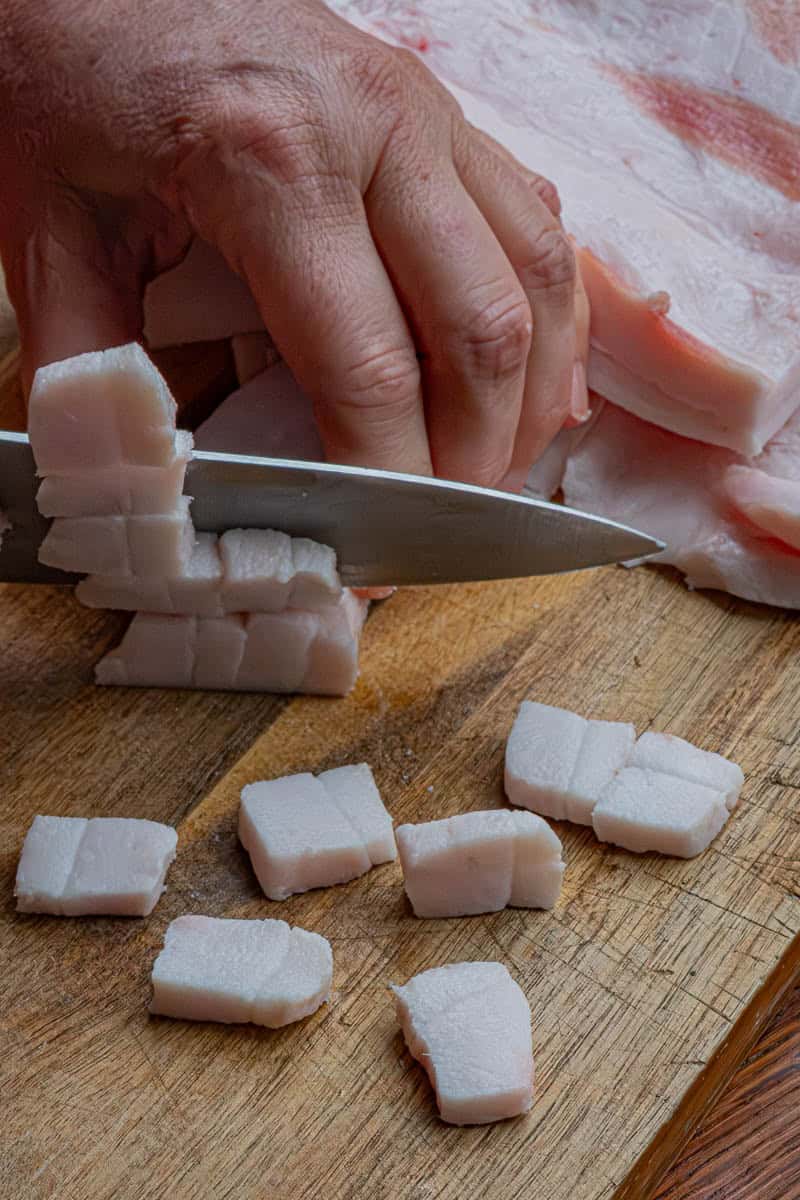
Cut the meat, fat and bacon

Cut the pork neck, fat and smoked pork into pieces small enough to fit into the hopper of your meat grinder.
Prepare the seasonings
Measure out the seasonings into a small bowl. Grate or mash the garlic so it's very fine and can incorporate evenly into the meat mixture. Set aside until meat is ground.
Grind the meat
Romanian sausages were historically made from meat that was cut by hand or otherwise ground using manual grinder which made for a very coarsely ground mixture with distinct pieces of fat and meat visible.
As far as Romanian sausages go, this is a feature not a bug. You want coarse and distinct pieces. Therefore when setting up your meat grinder, use a coarse grind plate.
The plate I used on my KitchenAid meat grinder is the coarsest plate available of three, which has 6 mm holes (about ¼").
Some manual grinders come with even coarser options with holes up to 10-12 mm (⅜-½").
Feed the pieces of meat into the hopper of the food grinder. Try to feed in alternating pieces of meat, fat and smoked meat so the mixture is more evenly combined. Ideally the meat mixture comes out marbled from even additions of meat and fat.
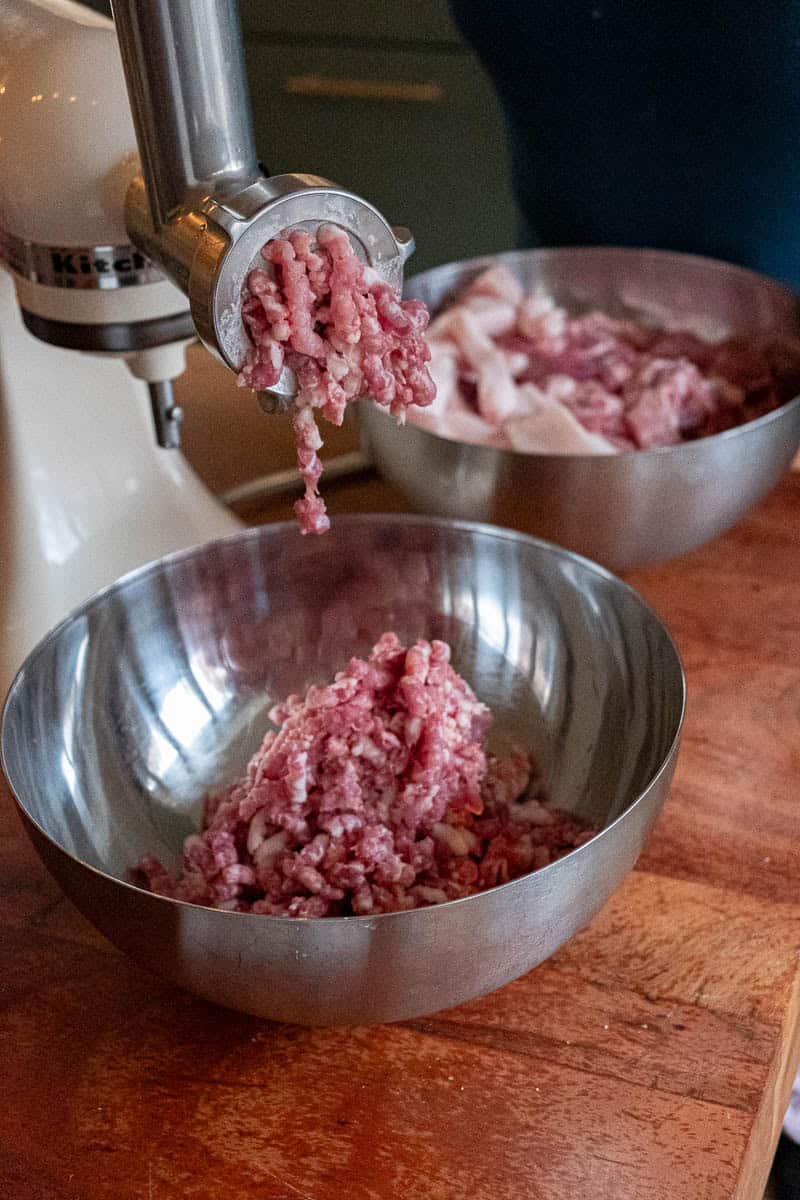
Once the meat is ground, add the seasonings along with room temperature water and mix well by hand until the mixture is evenly combined.

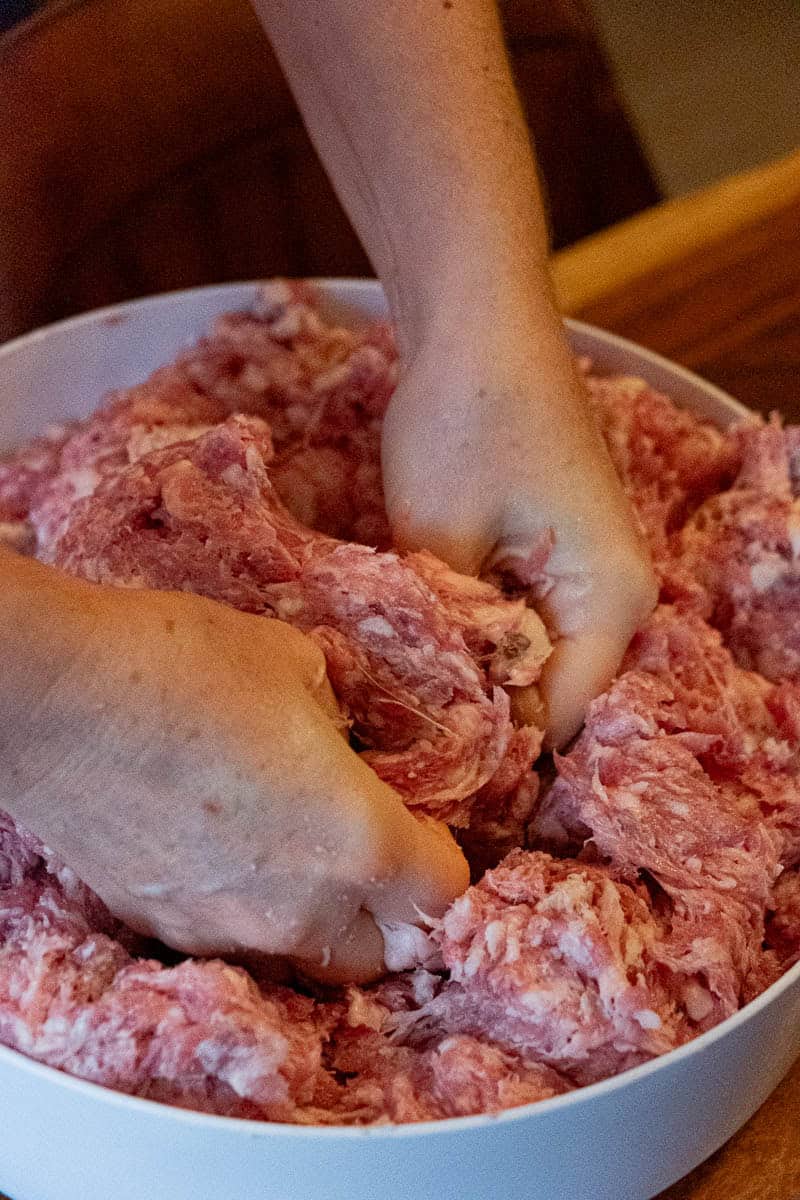
At this point you can fry up a small patty to taste and adjust the seasoning.
Some people leave this mixture to sit in the fridge over night so the flavors develop and the salt absorbs evenly throughout.
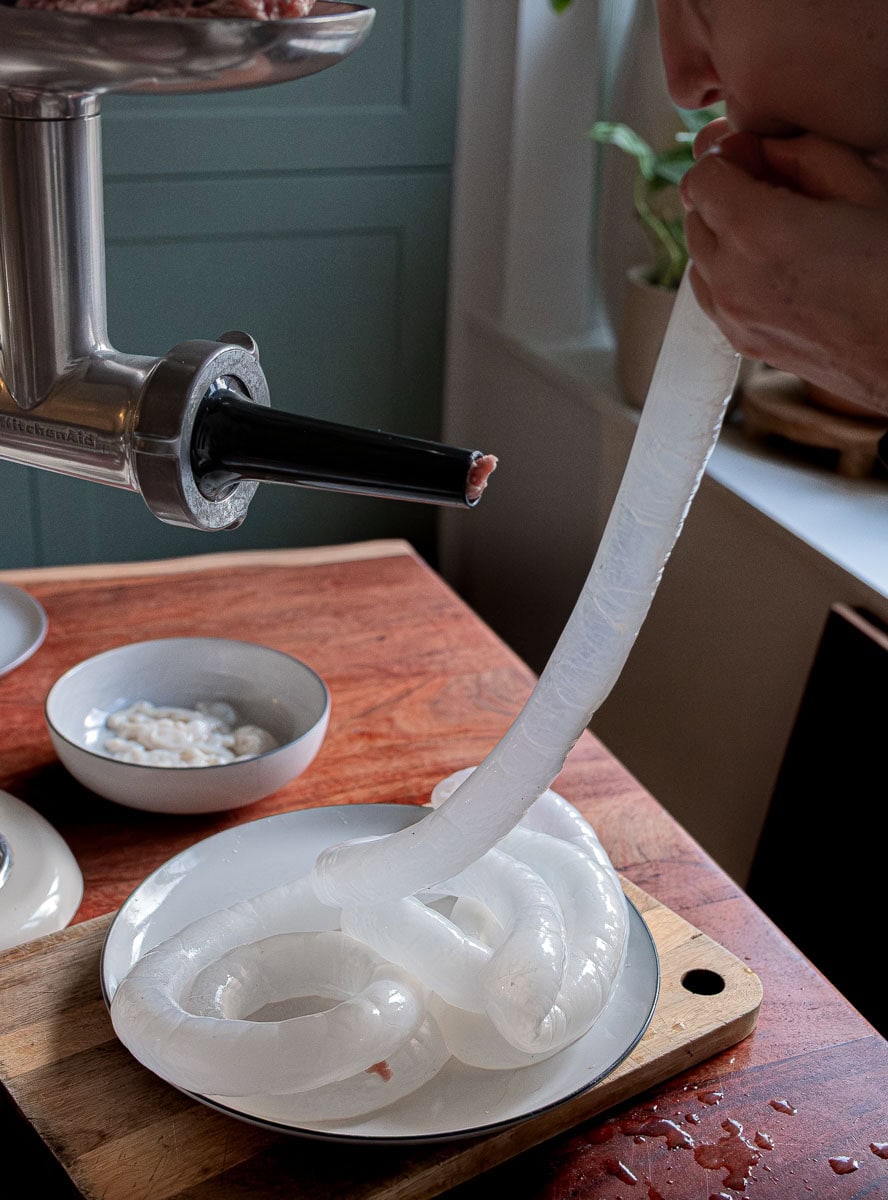
Once the meat mixture is seasoned to your liking, you can begin stuffing.
You'll want to use a wider sausage stuffer for wider casings like pork and a narrower stuffer for narrower casings like lamb.
The KitchenAid sausage stuffer comes with 2 stuffer attachments: a smaller one measuring 9.5 mm (⅜ inch) in diameter and a larger one measuring 15.9 mm (⅝ inch) in diameter. I used the larger attachment for these sausages since they are made with pork casings.
The old school way of doing it is to blow air with your mouth into each casing and then immediately feed it onto the stuffer attachment.


You should gently push all of the casing onto the stuffer until only a small bit of the end is hanging off. When ready to stuff, you'll twist that end slightly so it keeps the meat in the casing.
If it's your first time stuffing sausages you may want a second pair of hands on the ready to operate the stuffer - it can be challenging to feed meat into the stuffer and guide meat into the casings at the same time.
Use the lowest speed setting to start until you're comfortable with the rhythm (or stay at the lowest speed setting).
As the meat mixture comes out you want to keep even tension in the casing so the meat fills it evenly. It might take a bit of getting used to but you will quickly get the hang of it.
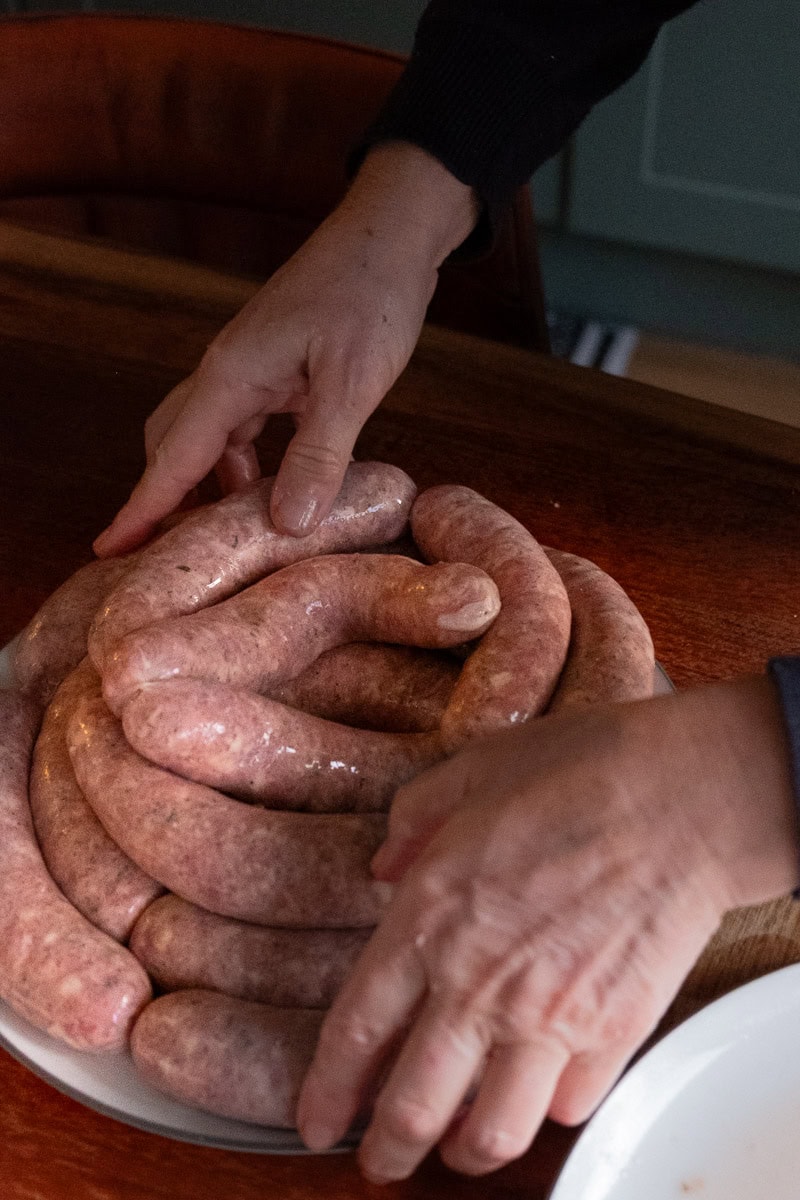
As the casings fill you can simply twist them around a few times to separate one sausage from another. Lay them onto a large plate or bowl as you go.

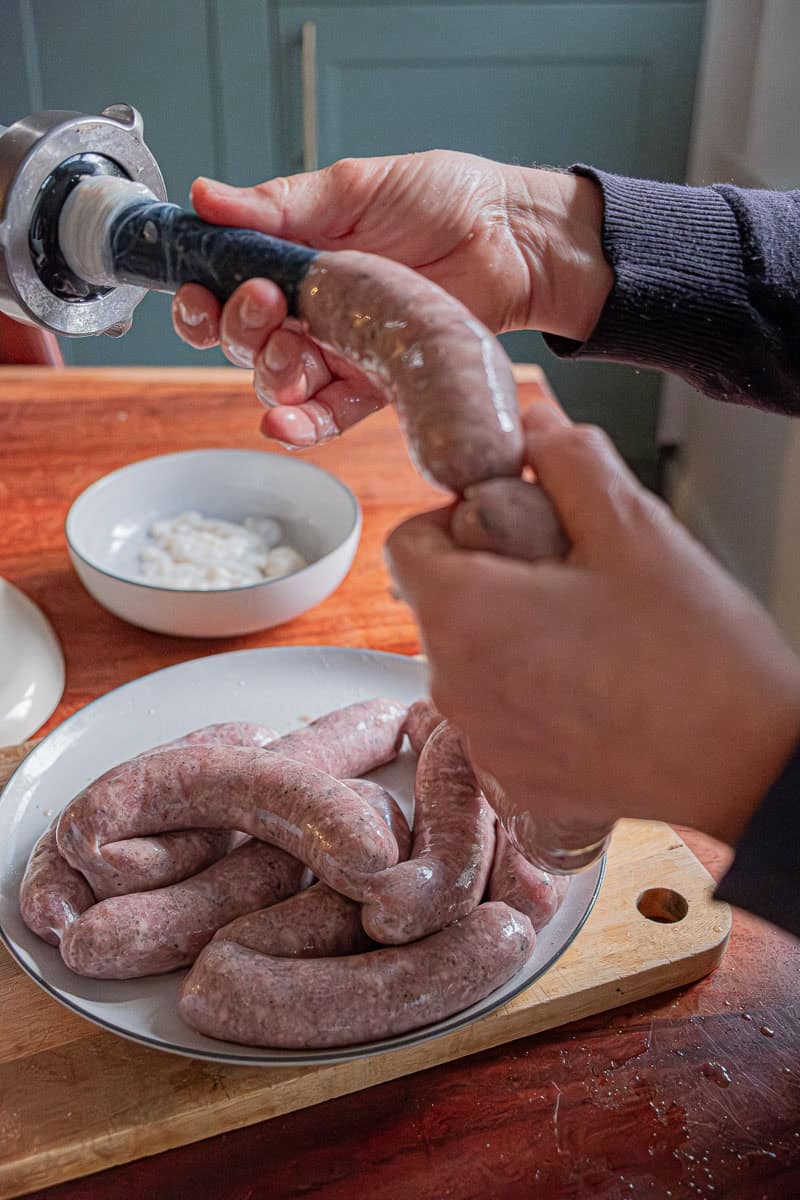
Once you've reached the end of the casing, do like at the beginning and leave a bit to twist and seal the sausage. You may need to arrange the sausages again by twisting to make sure each is differentiated. You can also use some twine to separate them if you prefer.
Dry, cook, or freeze the sausages
Once all the sausages are ready, you have a few options. The traditional approach is to dry them out for a day or so in a cold space or otherwise smoke them for later use.
You can dry them at home by hanging (for example on a pasta drying rack like I've done) and put them in the fridge for the night.
If you don't have the space you can also skip this step and just cook them up, refrigerate or freeze them for later use.
To freezer simply put the desired quantity into freezer bags and freeze. Frozen sausages are best within 2 months.

Troubleshooting

Cause: Overfilling, dry casings, or forcing meat through too quickly.
Solution:
Soak casings thoroughly (at least 30 minutes, ideally longer) and flush water through them.
Slow down the stuffer and let the casing fill gradually.
Stop filling as soon as the casing looks plump, not tight. You should be able to pinch and twist easily later.
Cause: Casings have doubled on themselves so there's an inner casing inside an outer casing. You can see how it looks in the photo below. Ours just came this way from the butcher.
Solution:
If you notice the casings have turned in on themselves (doubled up) before starting, you can sometimes fix it by flushing water through them. If that doesn't work you'll need to do it by hand, gently use a finger to pull the inner casing from inside the outer casing. If you've already started stuffing you'll need to start over by removing any meat mixture.
Cause: Meat not packed tightly in the stuffer or grinder; stuffing too fast.
Solution:
Press the meat firmly into the stuffer to eliminate air before starting.
Stuff at a steady, slow speed.
If air still gets in you can prick visible air bubbles with a clean needle.
Cause: Inconsistent stuffing speed or twisting too soon.
Solution:
Let the entire casing fill evenly before twisting into links.
Guide the sausage gently with one hand while stuffing, without squeezing. Hold even tension in each casing as you stuff it. Also don't worry too much about perfection, perfect execution may come with time and practice.
Serving Suggestion
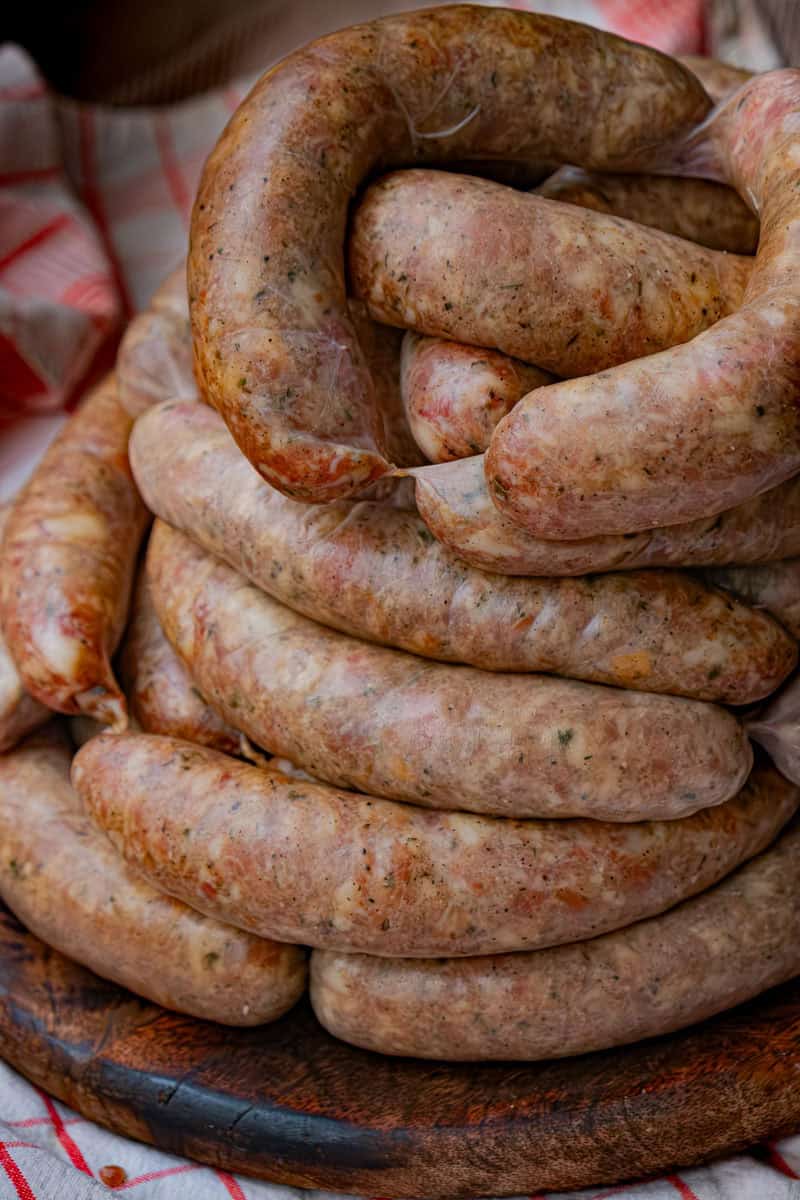
- With mămăligă: Grilled or pan-fried sausages served with hot mămăligă, telemea or feta-style cheese, and mustard.
- With bread: Served with crusty bread, mustard, and pickles for a simple meal.
- With mashed potatoes: Simply cooked sausages alongside buttery mashed potatoes and pickles.
- In tochitură: Sliced and cooked with pork chunks, served over mămăligă with a fried egg and cheese.
- With homemade Romanian murături (lacto-fermented pickled vegetables): Pickled cucumbers, cabbage, cauliflower, or green tomatoes to cut the richness.
Recipe

Homemade Romanian Sausages (Cârnați de Casă)
Ingredients
- 3.7 kg pork neck (ceafă de porc) 8.15lbs
- 700 grams pork belly fat 1.5lbs
- 200 grams cold smoked bacon 0.45lbs
- 120 grams pork casings 0.25lbs
- 80 grams salt 2.8oz
- 15 cloves garlic
- 4 tablespoons dried summer savory i.e. cimbru
- 2 tablespoons black pepper
- 2 tablespoons paprika (sweet or hot) optional to taste
- 500 ml water
Equipment
- meat grinder and sausage stuffer I used a KitchenAid stand mixer full metal food grinder and sausage stuffer.
Instructions
- Prepare casings: Rinse thoroughly and soak at least 30 minutes for fresh casings or 2 hours up to overnight for salt preserved casings; keep submerged until use.
- Chill everything: Keep meat, fat, grinder parts, and bowls very cold.
- Grind: Cut meat, fat, and bacon into chunks. Grind through a medium plate.
- Season: Add salt, garlic, pepper, cimbru, and paprika (if using).
- Mix: Mix, adding water a bit at a time, until the meat becomes smooth and cohesive (2-3 minutes).
- Stuff: Load casings onto the stuffer tube, start slowly, and fill evenly with even tension.
- Link: Twist into desired lengths, alternating directions. Prick air pockets if needed.
- Rest: Refrigerate sausages uncovered 2-12 hours, ideally hanging on a rack for air flow.
- To cook: Grill or pan-fry gently over medium heat until browned and cooked through.
- To freeze: Put sausages in freezer bags in quantity desired. Freeze up to 2 months for optimal freshness. Defrost before cooking.
Notes
- Cuts with god marbling like boneless pork shoulder or butt. See post for full substitution information.


Comments
No Comments