

If you're landing here I'm going to assume you have a real problem on your hands - a pot of over-salted soup that you need to fix now.
The first part of this post gives you quick fixes to solve the issue without diluting the flavor in your soup and having to start over.
And if you're curious the second part has some tips for preventing over-salting in the future.
Table of contents
Quick Summary
- An overly salty soup is best corrected with dilution by liquids (water, stock etc.) or solids (potato, rice etc.).
- To prevent flavor-loss, only add the minimum needed to dilute - do this by adding a bit at a time.
- Always bring soup back up to simmer after adding anything so everything is evenly warm and the salt can distribute evenly.
- For a very slightly over-salted soup, sometimes you can rebalance it by adding a tiny amount (0.5 teaspoon) of acid like vinegar or lemon juice. This just masks the saltiness without substantially changing the flavor.
Why a Potato Won't Work
It's a folksy piece of kitchen wisdom that seems near universal. I've heard it many times from my own Romanian heritage. But unfortunately the potato trick for salty soup does not work.
This is what actually happens:
- A potato only absorbs the small amount of liquid that physically fits inside it.
- That liquid has the same salt concentration as the rest of the soup.
- The total amount of salt "removed" is therefore negligible compared to the volume of the pot.
Even if you remove the potato, the change in salt level is too small for your palate to detect.
Fix an Over-Salted Soup Now (Without Diluting Flavor)
The first line of defense for a salty soup isn't a potato, it's dilution and rebalancing to prevent flavor loss.
Best Option: Sparingly Dilute with Liquids or Solids
The best solution to a salty soup is dilution with either more liquid or more solids. As the old saying goes: the solution to pollution is dilution
Both methods work for the same reason: they reduce the overall salt concentration of the pot.
How to Dilute Salt Without Diluting Flavor?
The amount of liquid or solid it takes to dilute an over-salted soup is actually not a lot. This is because the amount of salt it takes to push a soup from well seasoned to over-salted is likewise not a lot.
Salting isn't something to do once and then check off your list; be constantly aware of how a dish tastes as it cooks, and how you want it to taste at the table. At San Francisco's legendary Zuni Café, chef Judy Rodgers often told her cooks that a dish might need "seven more grains of salt." Sometimes it really is that subtle; just seven grains can mean the difference between satisfactory and sublime. - Samin Nosrat, Salt, Fat, Acid, Heat
In a typical 3-liter pot of soup, the difference can be as little as ½ teaspoon of salt.
By the same token, it doesn't take much to restore balance. So only add a little at a time, warm and taste in between.
It's time consuming taking is slow but can end up saving you time and frustrating if you're overshooting the mark by adding too much.
How to Dilute with Liquid
Add more unsalted liquid, such as:
- water
- unsalted stock
- cream or milk (when appropriate)
We only want salt dilution, not flavor dilution. To just dilute the salt, add the minimum amount of liquid necessary to restore balance.
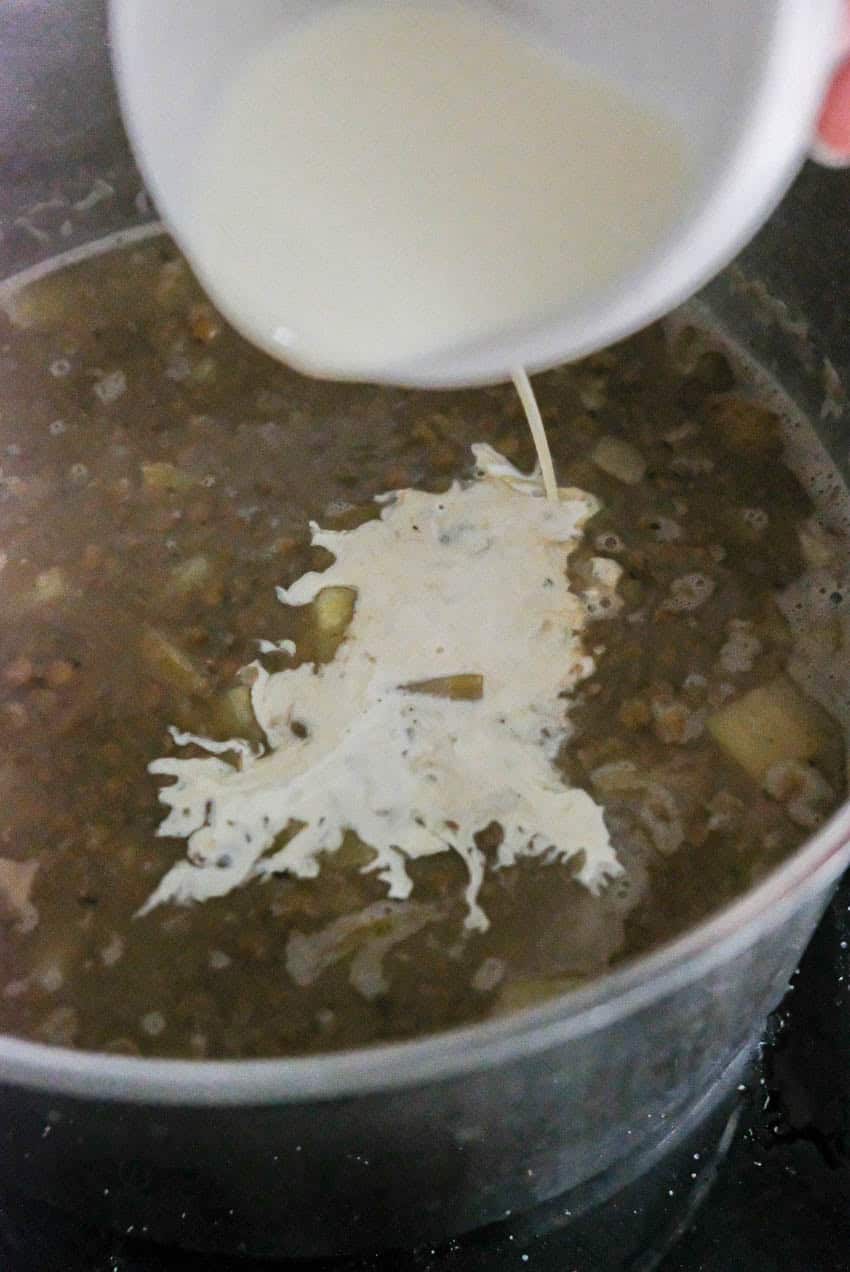
It's hard to say exactly how much that is because it depends on a lot of factors (amount of liquid, amount of solids etc.). It could be as little as a few tablespoons to 0.25 cup of extra liquid or it could be more.
Therefore, the best way to go about dilution is to only add at most 0.25 cup of additional liquid at a time. If diluting with a somewhat sweeter liquid (cream or vegetable stock) then it can be even less.
Be sure to bring the soup back up to simmer after adding any amount of liquid. Stir to combine the new liquid with the rest.
All the contents of the soup need to be stirred well and evenly warmed through in order to help the salt and other ingredients distribute more uniformly.
Taste after mixing well and when the soup is warm, not hot.
Besides burning our taste buds, hot food is harder to taste. The perception of taste decreases when a food's temperature rises beyond 35°C. - Samin Nosrat, Salt, Fat, Acid, Heat
Then taste and see if balance is restored. Repeat adding a bit of liquid at a time until it's perfect. If the soup tastes flat, you will need to take some steps to restore flavor balance.
How to Dilute with Solids
Add more unsalted ingredients that belong in the soup, such as:
- potatoes
- rice or pasta
- beans or lentils (red lentils are especially good for heartier soups as they can dissolve fully and just contribute thickening without adding a different flavor)
- vegetables
Solid dilution is especially useful when:
- the soup is already thick or hearty
- adding more liquid would make it too thin
- you want to preserve body while reducing salt
Diluting with solids works on the same principle as liquid dilution: you increase the total volume of food in the pot without increasing the amount of salt.
As the added ingredients cook, they absorb some of the surrounding liquid and release starches or vegetable juices. This lowers the overall salt concentration and softens the perception of saltiness.
Start by adding a small amount of unsalted solids that already make sense for the soup.
Let the soup simmer and mix well so the new ingredients can fully cook and integrate. Once everything is cooked, taste and adjust.
If the soup starts to feel too thick after adding solids, you can always follow up with more liquid following the directions above so you don't dilute the flavor.
Other Options: Fat, Acid or Sugar?
As you can see from the above, dilution doesn't have to be so aggressive as to dilute out the flavor you've worked hard to develop. A little rebalancing is usually enough.
But if you're still reluctant to dilute and your soup or stew is only slightly salty tasting, you can try a tiny amount of fat or acid such as:
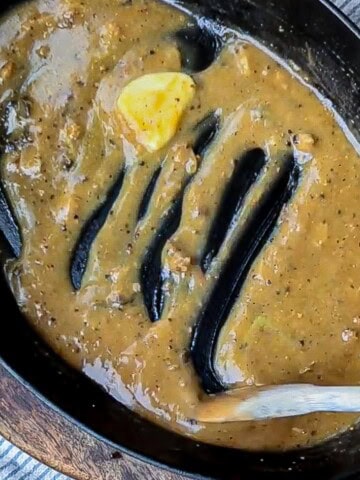
- Olive oil or unsalted butter;
- Lemon juice, white wine or red wine vinegar (milder than white), balsamic vinegar (also a bit sweet).
Start with only a teaspoon of fat or a few drops of acid then warm back up, stir well and taste.
Sugar can also work but must be used very sparingly (a quarter teaspoon) to avoid creating unpleasant bitterness from the mixing of too much salt and sugar.
In my experience a little sprinkle of sugar works best for tomato-based dishes.
How to Prevent Overly Salty Soup in the Future
Over-salting can happen to anyone. It's especially easy in soups and stews because you taste salt less in warm foods.
To prevent over-salting in future, add a bit of salt at the start then near the end allow the soup to cool slightly to a comfortable eating temperature and taste at least one tablespoon - if more salt is needed adjust by adding just a little at a time.
Related
Check out more posts on cooking foundations.


Comments
No Comments